.svg)
Digital Wayfinding Growth in the Healthcare Market
Hospital wayfinding is growing fast. Why healthcare is leading the digital navigation market shift.
.png)
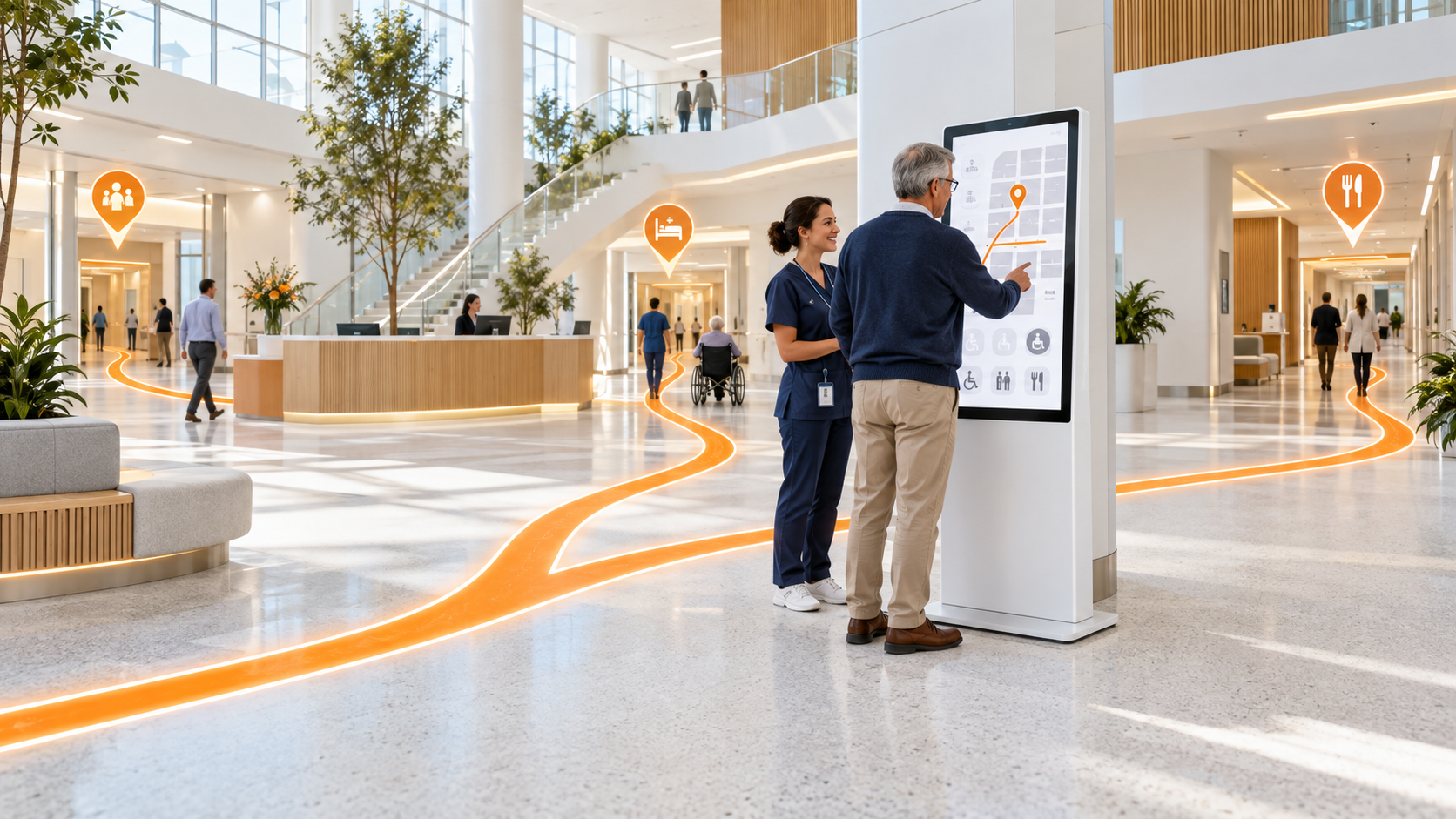
Hospital wayfinding is no longer a nice-to-have. It is becoming a core piece of healthcare infrastructure.
The global market for digital wayfinding in healthcare has been growing at compound annual rates exceeding 15% since 2020, and that trajectory shows no sign of slowing through 2030. For anyone working in hospital planning, patient experience, or digital health investment, that number is worth understanding. Not just as a market signal, but as a reflection of something hospitals are actually experiencing on the ground.
Why Healthcare Is Leading This Shift
Hospitals are complex environments. Multi-building campuses. Hundreds of departments. Rotating staff, stressed patients, and visitors who have never been there before. Getting lost in a hospital is not just inconvenient. It delays treatment, increases staff burden, and affects how patients feel about the care they receive before they have even seen a clinician.
Digital wayfinding addresses this directly. Interactive kiosks, mobile-based navigation, and integrated directory systems give patients and visitors a clear, reliable path through facilities that would otherwise require constant human direction. The operational benefit is measurable. Staff spend less time giving directions. Appointment punctuality improves. Patient experience scores move.
Post-pandemic, the pace of adoption accelerated. COVID-19 forced hospitals to rethink physical flows, reduce crowding, and create cleaner patient pathways. Digital wayfinding systems, particularly touchscreen kiosks and mobile-first navigation, proved their value in that context and stayed.
What Hospitals Are Looking For
The healthcare organisations moving fastest on digital wayfinding share a few common priorities.
They want systems that work with what they already have. Legacy infrastructure, existing hospital information systems, and established IT governance mean that new solutions need to integrate cleanly, not require a rip-and-replace approach. Cloud-based platforms have made this significantly more manageable, and they are now a baseline expectation rather than a premium feature.
They want accessibility built in, not bolted on. WCAG compliance, multilingual support, and interfaces designed for users with cognitive or mobility challenges are procurement requirements in most Australian healthcare settings. Systems that treat accessibility as an afterthought do not make it past the tender stage.
They want local support. A system that goes down at 7am on a Monday and requires a support ticket to an overseas team is not a viable option in a hospital environment. Australian healthcare organisations are increasingly prioritising vendors with local presence and responsive service arrangements.
Where Envent Fits
Envent has spent over two decades building digital wayfinding for Australian hospitals, shopping centres, and government facilities. The healthcare market expansion that analysts are projecting is something Envent has been living for decades.
What makes healthcare wayfinding different from other environments is the emotional stakes. A patient navigating to oncology or cardiology is not in the same headspace as a shopper looking for a store. The system has to work the first time, communicate clearly under pressure, and be accessible to every person who uses it, regardless of age, language, or ability.
That is the standard Envent designs to. Award-calibre kiosk industrial design, software built for complex multi-building campuses, and AI-ready systems designed to grow with the hospitals they serve.
The market is growing because the need is real. Hospitals that have invested in digital wayfinding are not going back to static signage and staff-directed navigation. The question now is not whether to invest, but how to choose the right partner for an environment where getting it wrong has consequences.