Hospital Wayfinding Tender Checklist: 30 Questions to Ask Before You Buy
Your guideline for Hospital wayfinding tender - what to put in scope and 30 questions to ask.

Most hospital wayfinding projects go wrong before a single sign is made. The brief asks for "digital wayfinding", three suppliers quote three different things, and nobody owns the names on the wall.
This checklist fixes that. It covers the Australian guidelines to reference, what should be in scope, and 30 questions to ask every supplier before you sign.
Short on time? Download the printable checklist (PDF). Tick it off in your next planning meeting.
Start with the guidelines that already apply
You don't need to invent requirements. Australian health departments have published wayfinding guidance, and your brief should point to it.
GuidanceWho publishes itWhat it's useful forWayfinding for Healthcare Facilities (2nd edition, 2022)NSW Health, Health InfrastructureA system-wide approach to wayfinding, not just signs. Covers precincts, transport, use of technology, Aboriginal cultural safety, universal design and welcome areas. Says terminology must be clear and consistent across every part of wayfinding.Wayfinding design principlesQueensland HealthMinimum standards for wayfinding design, early integration into project planning, universal design, and alignment with Queensland Health naming conventions.Wayfinding and signage guidelines (2009)Victorian Department of HealthPrinciples for wayfinding to and within emergency departments. Lists digital kiosks and screens among the tools.NSQHS Standards, Action 1.31Australian Commission on Safety and Quality in Health CareHealth services must use signage and directions that are clear and fit for purpose. The Commission's guidance names interactive kiosks and smartphone apps as strategies.AS 1428.4.2:2018Standards AustraliaWayfinding signs for people who are blind or have low vision.WCAG 2.2W3CThe accessibility benchmark for the kiosk software and the mobile experience.
Your project may also need to address the Disability Discrimination Act 1992, the Disability (Access to Premises - Buildings) Standards 2010 and AS 1428.1. Check the current versions with your access consultant.
NSW notes that emergency departments, mental health units and dementia units need their own current policies and standards. If your project touches these areas, list them in the brief.
Before you write the brief
- Who gets lost, and where? Walk the real journeys: car park or bus stop, to the entrance, to reception, to the clinic. Note where people stop and ask.
- Who are the users? Patients, carers, visitors, staff, contractors. Include older people, people with disability, people with low English literacy and people who are stressed or unwell.
- Is there an agreed destination list? One name for every department, used on signs, kiosks, phones, appointment letters and the website. If two names exist, pick one before you go to market.
- What's the scope of the site? One building, a campus, or a precinct with transport links and outdoor routes.
- What's changing in the next five years? New wings, department moves, staged openings. The system needs to keep up without a re-tender.
- Who owns wayfinding after go-live? Name a role, not a team. Someone has to approve name changes and map updates.
Decide what you're buying
The biggest gap in most briefs is scope. Write down which of these you need, and whether one supplier or several will deliver them:
- Wayfinding strategy and destination naming
- Physical signage (directional, wall, overhead, external)
- Digital kiosks
- Mobile wayfinding (kiosk to phone)
- Indoor maps (building them and keeping them current)
- Content management for staff
- Installation and commissioning
- Training
- Support and maintenance
If the work is split across a consultant, a sign maker, a kiosk supplier and an IT vendor, someone has to manage the gaps between them. Put that in the brief too.
30 questions to ask every supplier
Scope and accountability
- Which parts of the scope above do you deliver yourselves, and which do you subcontract?
- Who is our single point of contact during the project, and after go-live?
- How do you keep the names on physical signs, kiosks and phones the same?
- What do you need from us, and when? (Floor plans, naming list, IT access, site access.)
Maps and content
- Who builds the indoor maps, and from what source (CAD, PDF plans, site survey)?
- When a department moves, who updates the map, and how long does it take?
- Can our staff update destinations, hours and notices without calling you?
- Does one change update every kiosk and every phone at once?
- Can the system cover more than one building or campus from one platform?
Patients and visitors
- Do patients need to download an app to use the mobile route?
- How does a route move from the kiosk to a phone?
- Which languages are supported, and who translates destination names?
- Can the kiosk show step-free routes?
Accessibility
- How do the kiosk software and mobile experience address WCAG 2.2 AA? Ask for evidence, such as a recent accessibility review.
- What are the kiosk reach ranges and screen heights for wheelchair users?
- How is the kiosk used by someone who is blind or has low vision?
- Have you tested with people with disability? What changed as a result?
Hardware
- Is the kiosk built for 24/7 hospital use and for hospital cleaning products?
- Is the screen readable in bright entrances and lobbies?
- Where are spare parts held, and how fast can a faulty unit be fixed?
- Who designs and builds the hardware?
IT, data and privacy
- Where is data hosted, and does it stay in Australia?
- What data is collected from kiosk and phone use? Is any of it personal?
- What does the system need from our network and IT security team?
- Can it connect to other systems we use, now or later?
Support and cost
- What support is included, what are the hours, and who answers the phone?
- What is the total cost over five to seven years: hardware, licences, map updates, support and replacement?
- What happens to our maps and content if the contract ends? In what format do we get them back?
Proof
- Which hospitals have run your system for two years or more? Can we speak to one?
- Can you demo the system on our own floor plan before we decide?
After you choose
- Test with real people. Run a short walk-through with patients and visitors, including people with disability and people with low English literacy.
- Measure before and after. Staff time spent giving directions, late or missed appointments, the most-searched destinations.
- Set a review cycle. Departments move. Agree who checks the names, signs and maps, and how often.
Download the checklist
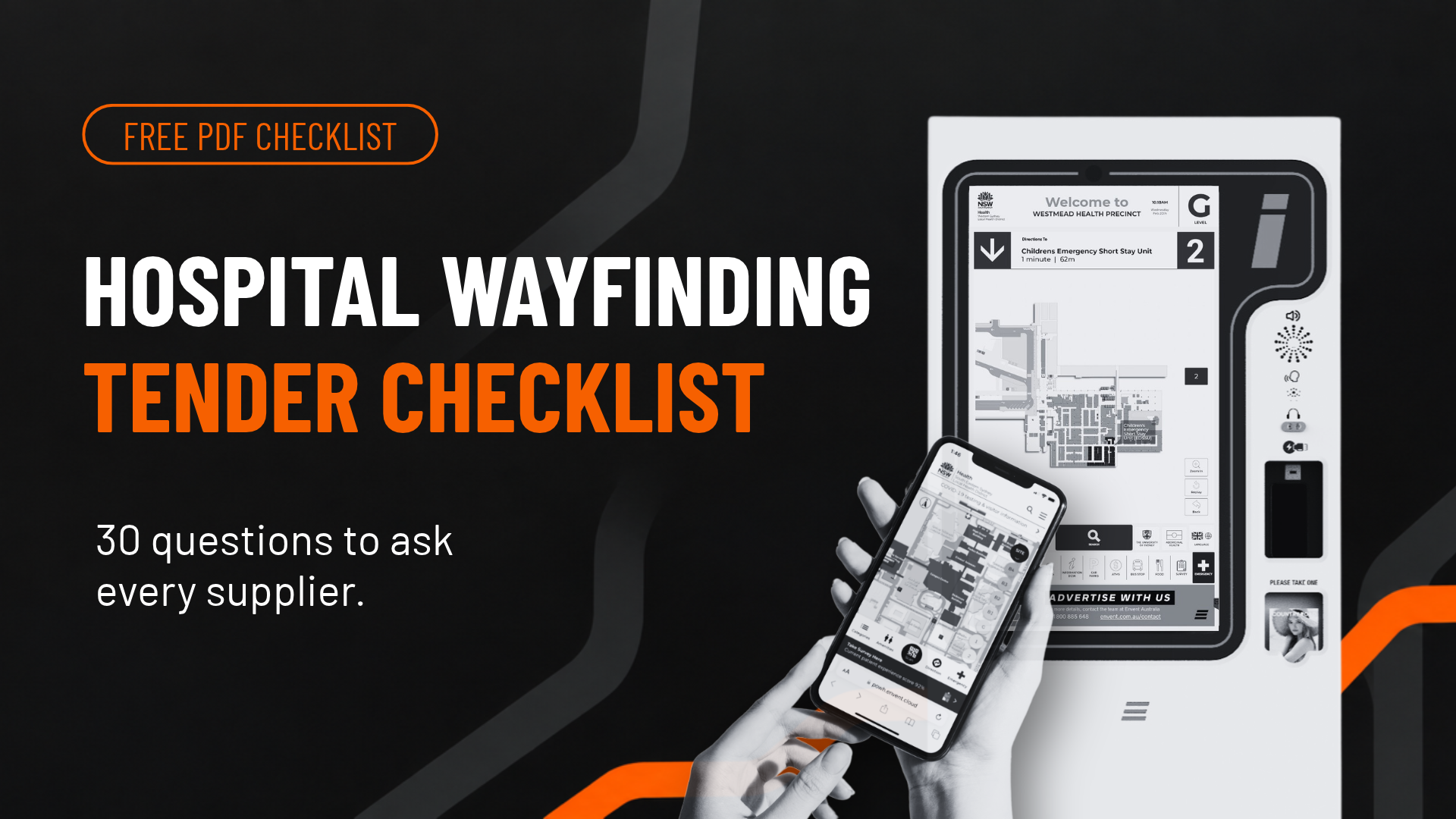
The full checklist is a three-page printable PDF, built for planning meetings and evaluation panels.
Download the hospital wayfinding tender checklist
If you'd like a second pair of eyes on your brief, book a 30-minute call with Justin Dean, Director of Envent Australia. Envent has delivered hospital wayfinding in Australia since 2004, from strategy and signage to kiosks, mobile and support.
This checklist summarises publicly available guidance as of October 2026. It doesn't replace the guidelines or professional advice. Always check the current version of each document.
Frequently asked questions
What guidelines apply to hospital wayfinding in Australia?It depends on the state. NSW Health publishes Wayfinding for Healthcare Facilities (2nd edition, 2022). Queensland Health publishes Wayfinding design principles. Victoria's Department of Health publishes wayfinding and signage guidelines for emergency departments. Nationally, NSQHS Action 1.31 requires clear, fit-for-purpose signage and directions, and AS 1428.4.2:2018 covers wayfinding signs for people with vision impairment.
What should a hospital wayfinding tender include?The guidelines you'll reference, an agreed destination naming list, the scope (strategy, physical signage, kiosks, mobile, maps, content management, installation, training and support), who is accountable for each part, and how maps will be kept current after go-live.
Should hospital wayfinding need an app?Ask every supplier. Many patients won't download an app for a single visit. Systems where the route continues from the kiosk to the phone's browser remove that step.
Who should update hospital maps after go-live?Agree it in the contract. The best setups let hospital staff update destinations and maps themselves from one login, with the supplier available to make changes when asked.
Sources (checked 30 Oct 2026)
- NSW Health, Wayfinding for Healthcare Facilities: https://www.health.nsw.gov.au/Hospitals/Pages/wayfinding-for-healthcare-facilities.aspx
- NSW Health Information Bulletin IB2022_048: https://www1.health.nsw.gov.au/pds/ActivePDSDocuments/IB2022_048.pdf
- Queensland Health, Wayfinding design principles: https://www.health.qld.gov.au/system-governance/health-infrastructure/resources/wayfinding-design-principles
- Victorian Department of Health, Wayfinding and signage guidelines (2009): https://health.vic.gov.au/publications/improving-the-patient-experience-program-wayfinding-and-signage-guidelines-2009
- ACSQHC, NSQHS Action 1.31: https://www.safetyandquality.gov.au/node/3610
- Standards Australia, AS 1428.4.2:2018: https://www.standards.org.au/news/fresh-guidance-to-help-the-vision-impaired